
Thursday, May 31, 2012

Nanodevice manufacturing strategy using DNA 'Building blocks'
 |
Wyss researchers have builtnumerals,letters and a number of other structures using short strands of DNA as building blocks. |
Researchers have developed a method for building
complex nanostructures out of interlocking DNA "building blocks" that
can be programmed to assemble themselves into precisely designed shapes. With
further development, the technology could one day enable the creation of new
nanoscale devices that deliver drugs directly to disease sites.
DNA is best known as a keeper of genetic information. But in an emerging field of science known as DNA nanotechnology, it is being explored for use as a material with which to build tiny, programmable structures for diverse applications. To date, most research has focused on the use of a single long biological strand of DNA, which acts as a backbone along which smaller strands bind to its many different segments, to create shapes.
Story source:
The above story is republished from materials provided by Wyss Institute for Biologically Inspired Engineering at Harvard.
Note: For further information, please contact the source cited above.
Wednesday, May 30, 2012
Chemical fingerprinting tracks the travels of little brown bats

A novel technique using stable hydrogen isotopes, a chemical fingerprint found in tissues such as hair, has enabled
researchers to determine where hibernating bats originated. Knowing that could
help predict and ultimately manage the spread of white-nose syndrome.
Story Source:
The above story is republished from materials provided by Michigan Technological UniversityNote: please contact the source cited above
Copper-Nickel Nanowires Could Be Perfect Fit For Printable Electronics

Duke University chemists created a new set of flexible, electrically conductive nanowires from thin strands of copper atoms mixed with nickel. The copper-nickel nanowires, in the form of a film, conduct electricity even under conditions that break down the transfer of electrons in plain silver and copper nanowires, a new study shows.
Story Source:
The above story is republished from materials provided by University of DukeNote: please contact the source cited above
Tuesday, May 29, 2012
New effective treatment for tinnitus?
Scientists have demonstrated the effectiveness
of a new tinnitus treatment. Tinnitus is the perception of a noxious disabling
internal sound without an external source. Roughly fifteen percent of the
population suffers from this disorder in varying degrees along with the
associated concentration problems, sleep disturbances, anxiety, depression and
extreme fatigue.
Sometimes this disorder is so disruptive it seriously impairs their daily functioning and, unfortunately, there is no cure.
The research conducted by Rilana Cima and her colleagues, however, indicates that cognitive behavioural therapy can help improve the daily functioning of tinnitus patients.
Monday, May 28, 2012
Computer model pinpoints prime materials for efficient carbon capture
 |
| One of the 50 best zeolite structures for capturing carbon dioxide. Zeolite is a porous solid made of silicon dioxide, or quartz. In the model, the red balls are oxygen, the tan balls are silicon. The blue-green area is where carbon dioxide prefers to nestle when it adsorbs. (Berend Smit laboratory, UC Berkeley) |
When power plants begin capturing their carbon emissions to reduce greenhouse gases – and to most in the electric power industry, it’s a question of when, not if – it will be an expensive undertaking.
Current technologies would use about one-third of the energy generated by the plants – what’s called “parasitic energy” – and, as a result, substantially drive up the price of electricity.
But a new computer model developed by University of California, Berkeley, chemists shows that less expensive technologies are on the horizon. They will use new solid materials like zeolites and metal oxide frameworks (MOFs) that more efficiently capture carbon dioxide so that it can be sequestered underground.
Story Source:
The above story is republished from materials provided by UC BerkeleyNote: please contact the source cited above
Drug Found for Parasite that is Major Cause of Death Worldwide
 |
| Entamoeba histolytica cyst |
identification of an existing drug that is effective against Entamoeba histolytica. This parasite causes amebic dysentery and liver abscesses and results in the death of more than 70,000 people worldwide each year.
Story Source:
The above story is republished from materials provided by UC San Diego School of MedicineNote: please contact the source cited above
Friday, May 25, 2012
Pivotal role for proteins: From helping turn carbs into energy to causing devastating disease
Research into how carbohydrates are converted
into energy has led to a surprising discovery with implications for the
treatment of a perplexing and potentially fatal neuromuscular disorder and
possibly even cancer and heart disease.
“The ability to convert carbohydrates into energy is critical for people and other organisms to live. But when that process goes awry, potentially fatal health problems can occur” “If we can figure out a way to correct the defects, we might be able to treat the disease.”
“The ability to convert carbohydrates into energy is critical for people and other organisms to live. But when that process goes awry, potentially fatal health problems can occur” “If we can figure out a way to correct the defects, we might be able to treat the disease.”
Story Source:
The above story is republished from materials provided by University of Utah Health ScienceNote: please contact the source cited above
Thursday, May 24, 2012
Hormone plays surprise role in fighting skin infections
 |
| Staphylococcus aureus, magnified 50 thousand times. |
Antimicrobial peptides (AMPs) are molecules
produced in the skin to fend off infection-causing microbes. Vitamin D has been
credited with a role in their production and in the body’s overall immune
response, but scientists say a hormone previously associated only with
maintaining calcium homeostasis and bone health is also critical, boosting AMP
expression when dietary vitamin D levels are inadequate.
The immunological benefits of vitamin D are controversial. In cultured cell studies, the fat-soluble vitamin provides strong immunological benefits, but in repeated studies with humans and animal models, results have been inconsistent: People with low levels of dietary vitamin D do not suffer more infections. For reasons unknown, their immune response generally remains strong, undermining the touted immunological strength of vitamin D
Story Source:
The above story is republished from materials provided by University of California, San Diego Health SciencesNote: please contact the source cited above
Wednesday, May 23, 2012
How Nanotechnology Can Help Detect Disease Earlier
Researchers shows a new way to precisely detect a single chemical at extremely low concentrations and high contamination.
The ability to detect a chemical at a low concentration and high contamination is especially important for environmental surveillance, homeland security, athlete drug monitoring, toxin/drug screening, and earlier disease diagnosis.
Story Source:
The above story is republished from materials provided by University of Kentucky.
Note: please contact the source cited above
Scientists turn patients’ skin cells into heart muscle cells to repair their damaged hearts: first report
For the first time scientists have succeeded in taking skin cells from heart failure patients and reprogramming them to transform into healthy, new heart muscle cells that are capable of integrating with existing heart tissue.
Story Source:
The above story is republished from materials provided by University of California.
Note: please contact the source cited above
Tuesday, May 22, 2012
researchers develop way to strengthen proteins with polymers

Proteins are widely used as drugs, insulin for diabetics is the best known example, and as reagents in research laboratories, but they react poorly to fluctuations in temperature and are known to degrade in storage.
The polymers consist of a polystyrene backbone and side chains of trehalose, a disaccharide found various plants and animals that can live for long periods with very little or no water. An example many people will recognize is Sea- Monkeys, the 'novelty aquarium pet' introduced in 1962. Sea–Monkeys can be purchased as kits that contain a white powder; when water is added, the powder becomes small shrimp whose long tails are said to resemble those of monkeys.
Trehalose is known to stabilize proteins when water is removed, and as a result, it is an additive in several protein drug formulations approved by the Food and Drug Administration (FDA) to treat cancer and other conditions.
Story Source:
The above story is republished from materials provided by University of California.
Note: please contact the source cited above
Monday, May 21, 2012
Oxytocin improves brain function in children with autism
Preliminary results from an ongoing researches shows that oxytocin, a naturally occurring substance produced in the brain and throughout the body increased brain function in regions that are known to process social information in children and adolescents with autism spectrum disorders (ASD).
Story Source:
The above story is republished from materials provided by University of Wisconsin
Note: please contact the source cited above
Good news for nanomedicine: Quantum dots appear safe in pioneering study on primates
Quantum dots are tiny luminescent crystals that glow brightly in different colors. Medical researchers are eyeing the crystals for use in image-guided surgery, light-activated therapies and sensitive diagnostic tests. Cadmium selenide quantum dots are among the most studied, with potential applications not only in medicine, but as components of solar cells, quantum computers, light-emitting diodes and more.
Story Source:
The above story is republished from materials provided by University of Buffalo. Note: please contact the source cited above |
Friday, May 18, 2012
In chemical reactions, water adds speed without heat
Through an interaction with hydrogen atoms (green), a water molecule (magenta and blue) moves rapidly across a metal oxide surface. This atomic-scale speed leads to more efficient chemical reactions.Scientists have discovered how adding trace
amounts of water can tremendously speed up chemical reactions, such as
hydrogenation and hydrogenolysis, in which hydrogen is one of the reactants,
or starting materials.
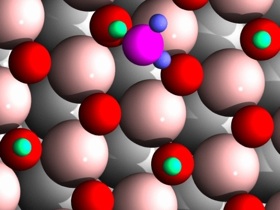 |
| Through an interaction with hydrogen atoms (green), a water molecule (magenta and blue) moves rapidly across a metal oxide surface. This atomic-scale speed leads to more efficient chemical reactions. |
Hydrogenation and hydrogenolysis reactions have huge applications in many key industrial sectors, including the petrochemical, pharmaceutical, food and agricultural industries. "In the petrochemical industry, for example, upgrading of oil to gasoline, and in making various biomass-derived products, you need to hydrogenate molecules-to add hydrogen-and all this happens through catalytic transformations.
A chemical reaction transforms a set of molecules (the reactants) into another set of molecules (the products), and a catalyst is a substance that accelerates that chemical reaction, while not itself being consumed in the process.
Story Source:
The above story is republished from materials provided by University of Wisconsin
Note: please contact the source cited above
Discovery Provides Blueprint for New Drugs That Can Inhibit Hepatitis C Virus
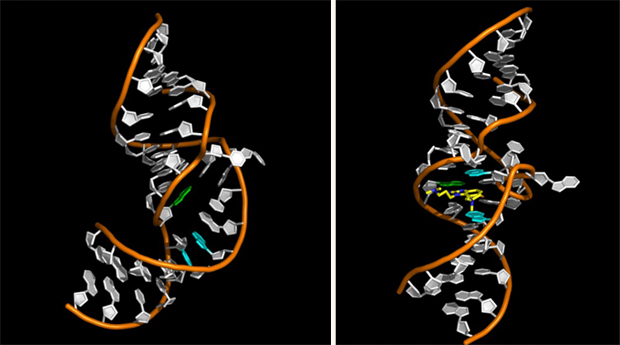
The molecule prompts the Hepatitis C’s viral RNA to open up a portion of its hinge-like structure and encapsulate the inhibitor like a perfectly fit glove.
Chemists at the
University of California, San Diego have produced the first high resolution
structure of a molecule that when attached to the genetic material of the
hepatitis C virus prevents it from reproducing. Hepatitis C is a chronic infectious disease that affects some 170 million
people worldwide and causes chronic liver disease and liver cancer.
Story Source:
The above story is republished from materials provided by UC San Diego news centerNote: please contact the source cited above
Thursday, May 17, 2012
Why Omega-3 Oils Help at the Cellular Level
 |
| ALA |
For the first time,
researchers at the University of California, San Diego have peered inside a
living mouse cell and mapped the processes that power the celebrated health
benefits of omega-3 fatty acids. More profoundly, they say their findings
suggest it may be possible to manipulate these processes to short-circuit
inflammation before it begins, or at least help to resolve inflammation before
it becomes detrimental.
The scientists fed mouse macrophages – a kind of white blood cell – three different kinds of fatty acid: eicosapentaenoic acid (EPA), docosahexaenoic acid (DHA) and arachidonic acid (AA). EPA and DHA are major polyunsaturated omega-3 fatty acids, essential to a broad range of cellular and bodily functions, and the primary ingredient in commercial fish oil dietary supplements. AA is a polyunsaturated omega-6 fatty acid prevalent in the human diet.
In high levels, fatty acids are toxic, so cells typically sequester them as phospholipids in their membranes. When stimulated, however, the fatty acids may be released, provoking a cascading inflammatory response. Acute or limited inflammation is, of course, a vital immunological response to physical damage or invasive pathogens. But chronic inflammation is harmful and a common element of almost every disease, from diabetes to cancer.
Story Source:
The above story is republished from materials provided by UC San Diego news centerNote: please contact the source cited above
Biologists Produce Potential Malarial Vaccine from Algae
 |
| The edible algae Chlamydomonas, seen here at UC San Diego, can be grown in ponds anywhere in the world. Credit: SD-CAB |
Biologists at the University of California, San Diego have succeeded in engineering algae to produce potential candidates for a vaccine that would prevent transmission of the parasite that causes malaria, an achievement that could pave the way for the development of an inexpensive way to protect billions of people from one of the world’s most prevalent and debilitating diseases. Initial proof-of-principle experiments suggest that such a vaccine could prevent malaria transmission.
Malaria is a mosquito-borne disease caused by infection with protozoan parasites from the genus Plasmodium. It affects more than 225 million people worldwide in tropical and subtropical regions, resulting in fever, headaches and in severe cases coma and death. While a variety of often costly antimalarial medications are available to travelers in those regions to protect against infections, a vaccine offering a high level of protection from the disease does not yet exist.
Story Source:
The above story is republished from materials provided by UC San Diego news centerNote: please contact the source cited above
Wednesday, May 16, 2012
Chronic Cocaine Use Triggers Changes in Brain's Neuron Structure
 |
| cocaine |
Chronic exposure to cocaine reduces the expression of a protein known to regulate brain plasticity, according to new, in vivo research on the molecular basis of cocaine addiction. That reduction drives structural changes in the brain, which produce greater sensitivity to the rewarding effects of cocaine.
Story Source:
The above story is republished from materials provided by University of Buffolo.Note: please contact the source cited above.
Drugs from lizard saliva reduces the cravings for food

A drug made from the saliva of the Gila monster lizard is effective in reducing the craving for food. Researchers at the Sahlgrenska Academy have tested the drug on rats, who after treatment ceased their cravings for both food and chocolate.
An increasing number of patients suffering from type 2 diabetes are offered a pharmaceutical preparation called Exenatide, which helps them to control their blood sugar. The drug is a synthetic version of a natural substance called exendin-4, which is obtained from a rather unusual source – the saliva of the Gila monster lizard (Heloderma suspectum), North America’s largest lizard.
Story Source:
The above story is republished from materials provided by UPMC/UNIVERSITY OF GOTHERNBURG.Note: please contact the source cited above.
Subscribe to:
Posts (Atom)