
Through an interaction with hydrogen atoms (green), a water molecule (magenta and blue) moves rapidly across a metal oxide surface. This atomic-scale speed leads to more efficient chemical reactions.Scientists have discovered how adding trace
amounts of water can tremendously speed up chemical reactions, such as
hydrogenation and hydrogenolysis, in which hydrogen is one of the reactants,
or starting materials.
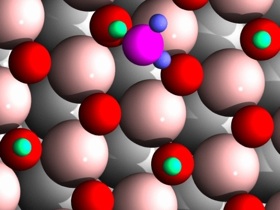 |
| Through an interaction with hydrogen atoms (green), a water molecule (magenta and blue) moves rapidly across a metal oxide surface. This atomic-scale speed leads to more efficient chemical reactions. |
Hydrogenation and hydrogenolysis reactions have huge applications in many key industrial sectors, including the petrochemical, pharmaceutical, food and agricultural industries. "In the petrochemical industry, for example, upgrading of oil to gasoline, and in making various biomass-derived products, you need to hydrogenate molecules-to add hydrogen-and all this happens through catalytic transformations.
A chemical reaction transforms a set of molecules (the reactants) into another set of molecules (the products), and a catalyst is a substance that accelerates that chemical reaction, while not itself being consumed in the process.
Story Source:
The above story is republished from materials provided by University of Wisconsin
Note: please contact the source cited above

No comments:
Post a Comment